
What to Put on a Salon Invoice
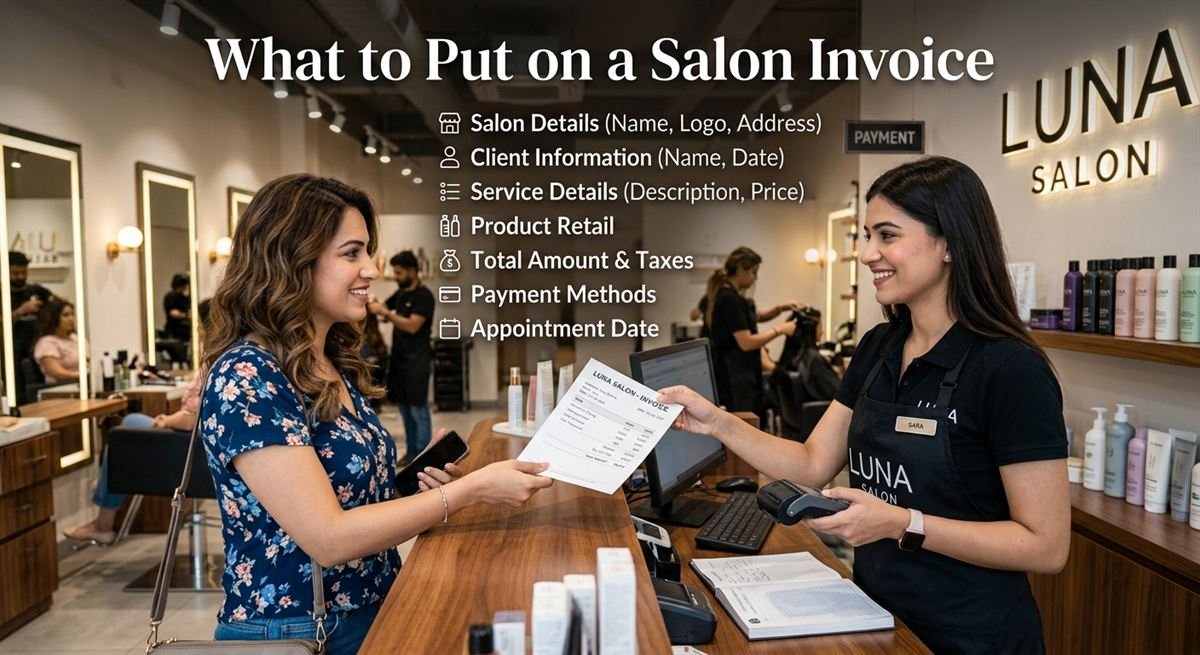
A salon invoice does three jobs at once. It tells the client what they paid for and gives you a record you can trust at closing time. Done well, it also reminds the client about your salon every time they scroll back through their phone.
Most salon bills manage the first job and miss the other two. Below is what a complete invoice looks like and why each line earns its place.
The 12 things every salon invoice should show
- Salon name, logo and address. The client should know who the bill is from without thinking.
- Phone or WhatsApp number. This is the line that turns an invoice into a rebooking.
- Invoice number. Sequential, never reused. It is how you find a bill again when a client disputes it.
- Date and time. The time matters for day-close and for checking who was on shift.
- Client name. Use "Walk-in" when there is no record, but try to capture the name.
- Each service and product on its own line, with quantity and price.
- Staff member. Useful for the client ("I want the same stylist") and essential for commission.
- Subtotal. Before any discount or tax.
- Discount shown as a separate negative line, never silently taken off the prices.
- Tax with its name and rate, if you charge it.
- Total, amount paid and balance. Three separate numbers when a client pays part now.
- Payment method. Cash, card, bank transfer or wallet. This is what makes your day close add up.
An example layout
| Line | Qty | Amount |
|---|---|---|
| Haircut & blow-dry (Ayesha) | 1 | 2,500 |
| Hair spa (Ayesha) | 1 | 3,000 |
| Argan oil serum (retail) | 1 | 1,800 |
| Subtotal | 7,300 | |
| Discount | − 300 | |
| Tax (5%) | 350 | |
| Total | 7,350 | |
| Paid (Card) | 5,000 | |
| Balance due | 2,350 | |
Tax here is calculated after the discount: (7,300 − 300) × 5% = 350. Always check which order your local tax rules require.
Discounts: show them, don't hide them
When a stylist takes 300 off a service price without writing it down, three things go wrong. The client doesn't feel they received a favour, your service prices in reports become meaningless, and nobody can tell later whether the discount was approved. A visible discount line fixes all three.
Tax: inclusive or exclusive?
If your menu prices already include tax, the invoice should show how much of the total is tax. If tax is added on top, show it as its own line after the discount. Mixing the two on one menu is the fastest way to confuse clients. Pick one approach, write it on your price list, and keep it consistent. Staff commission should normally be calculated on the amount before tax.
Part payments and advances
Bridal bookings, long treatment courses and regular clients who "pay next time" all create balances. The invoice has to show the total, what was paid today and what is still owed. That balance also needs to be recorded somewhere other than the stylist's memory. Our guide to letting clients pay later covers how to keep those balances from going bad.
Paper, thermal or WhatsApp?
- Thermal receipt (58 or 80 mm): fast, cheap, expected at the counter.
- A4 invoice: for corporate clients, bridal packages and anyone who needs to claim expenses.
- PDF on WhatsApp: the one clients actually keep. Your salon's name then sits in their chat list, one tap away from the next booking.
Common invoice mistakes
- Invoice numbers restarting every month or every book.
- No staff name, so commission is worked out from memory.
- Products used in the service (shampoo, colour) mixed up with products sold.
- Balances written on the bill but never recorded anywhere else.
- Editing an old bill by crossing out numbers.
Let the software do it
Salonipy's salon billing builds this invoice for you: numbered automatically, a stylist on every line, discount and tax lines, part payments that move to receivables, and a choice of thermal receipt, A4 invoice or WhatsApp PDF. Try it free for 7 days.
Related: Salon billing software · Letting clients pay later · Closing the till every night